Smart Interactive Desk (BEMO)
A desk that sees how you sit and adjusts its own height and tilt, with instant light feedback and a dashboard of longer-term patterns.
My partTeam lead in a team of five
In short
A prototype that combines computer vision, ESP32 control, motorized height and tilt, immediate LED feedback, and a dashboard for longer-term patterns.
- What it is
- A prototype posture-aware desk that closes a physical loop between vision, control, and motion.
- Why it matters
- A posture model cannot be treated as an isolated prediction: camera placement, desk motion, false corrections, and mechanical limits all matter.
- My part
- I was team lead and the software/robotics engineer on our five-person senior graduation project, with Bassam Kousa, Ali Daaboul, Mohamad Berjawi, and Mohamad Hariri. Mohamad Berjawi and I made most of the commits.
Step by step
- 1
Observe
A desk-mounted camera estimates posture.
- 2
Decide
The ESP32 applies dead bands, mechanical limits, and slow transitions before acting.
- 3
Move
Motorized height and tilt actuators change the work surface.
- 4
Signal
Immediate LED feedback and a longer-term dashboard keep the user in the loop.
Results
- Best Senior Project
- Award
- senior graduation project, 2024–2025
From the project
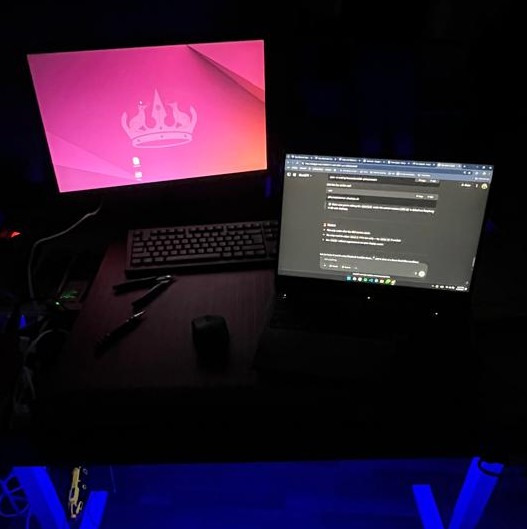
For engineersHow it is built, its limits, and its keywords.
How it works
A camera-based posture estimator informs an ESP32 controller with dead bands, mechanical limits, and slow transitions, driving motorized height and tilt while an LED and dashboard communicate state back to the user.
Limits
- The repository also covers handwriting capture, a music player, and desk-to-desk messaging; this page sticks to the posture loop.
- Formal test results are in the team’s project report, not in the repository.
Keywords
- posture estimation
- ESP32
- motorized desk
- closed loop