Thermal Super-Resolution
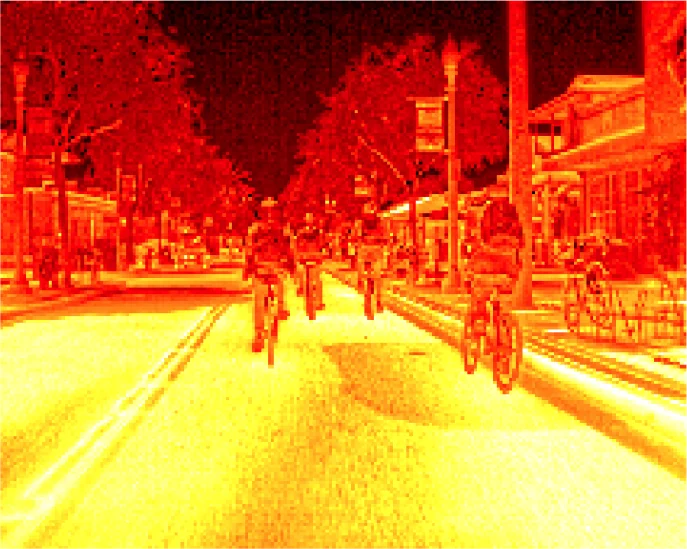
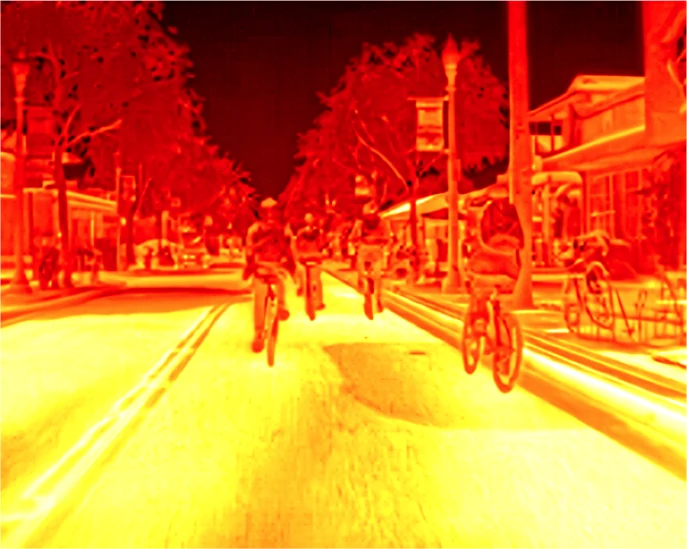
Makes low-resolution thermal camera images sharper, fast enough to run on the device beside the sensor.
My partComputer vision engineer
In short
An IMDN-derived single-channel thermal super-resolution pipeline trained with thermal-specific objectives and optimized for deployment on NVIDIA Jetson hardware.
- What it is
- A single-channel super-resolution pipeline that adapts an Information Multi-Distillation Network to thermal imagery for deployment near the sensor.
- Why it matters
- RGB-trained super-resolution models can hallucinate texture that has no thermal meaning, and higher-resolution thermal sensors are expensive relative to lower-resolution alternatives.
- My part
- I worked on the architecture adaptation, the training, and the edge inference.
Step by step
- 1
Adapt
Information Multi-Distillation Network layers are adapted from three-channel RGB to a single thermal channel to match sensor semantics.
- 2
Transfer
Weights pretrained on RGB provide a useful starting point in a domain where thermal training data is scarce.
- 3
Retrain
A thermal-specific objective moves the model toward gradients, contrast, and structure that belong to heat imagery, rather than photographic texture priors.
- 4
Deploy
Inference is moved toward FP16 and INT8 execution and measured as a complete pipeline on named NVIDIA Jetson hardware, not as a bare model file.
Results
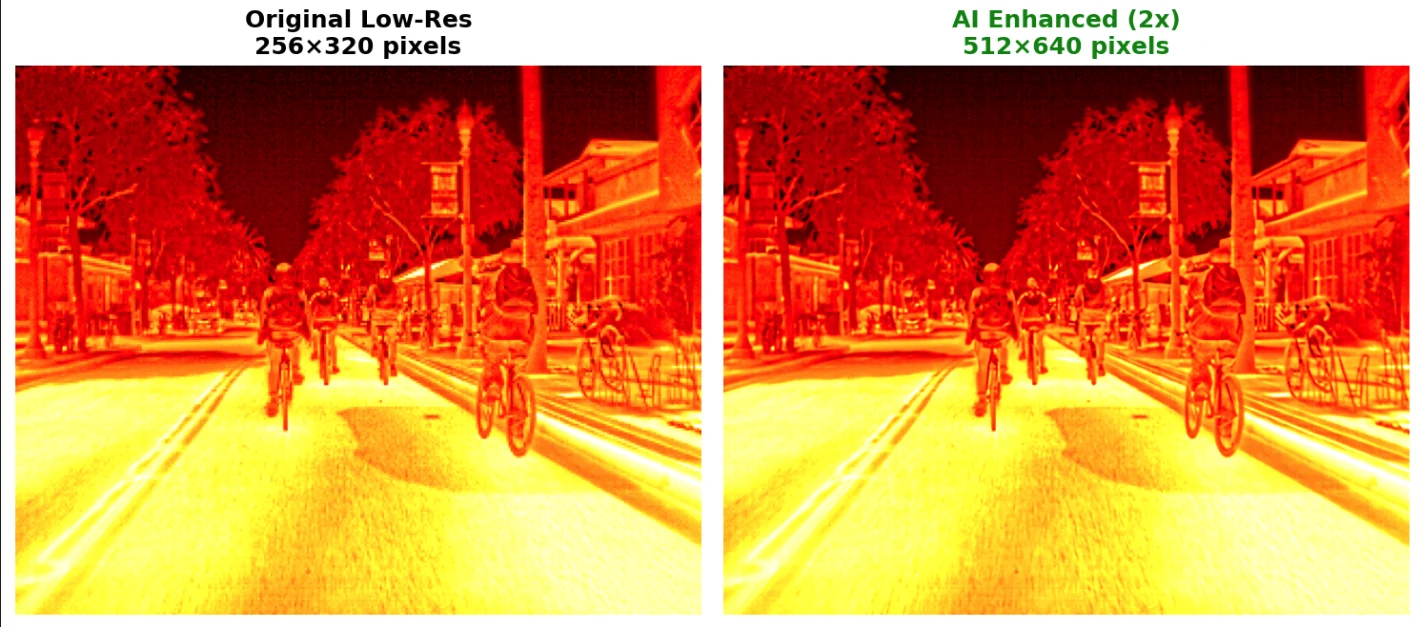
- 34.2 dB / 0.840
- ×2 quality
- PSNR / SSIM
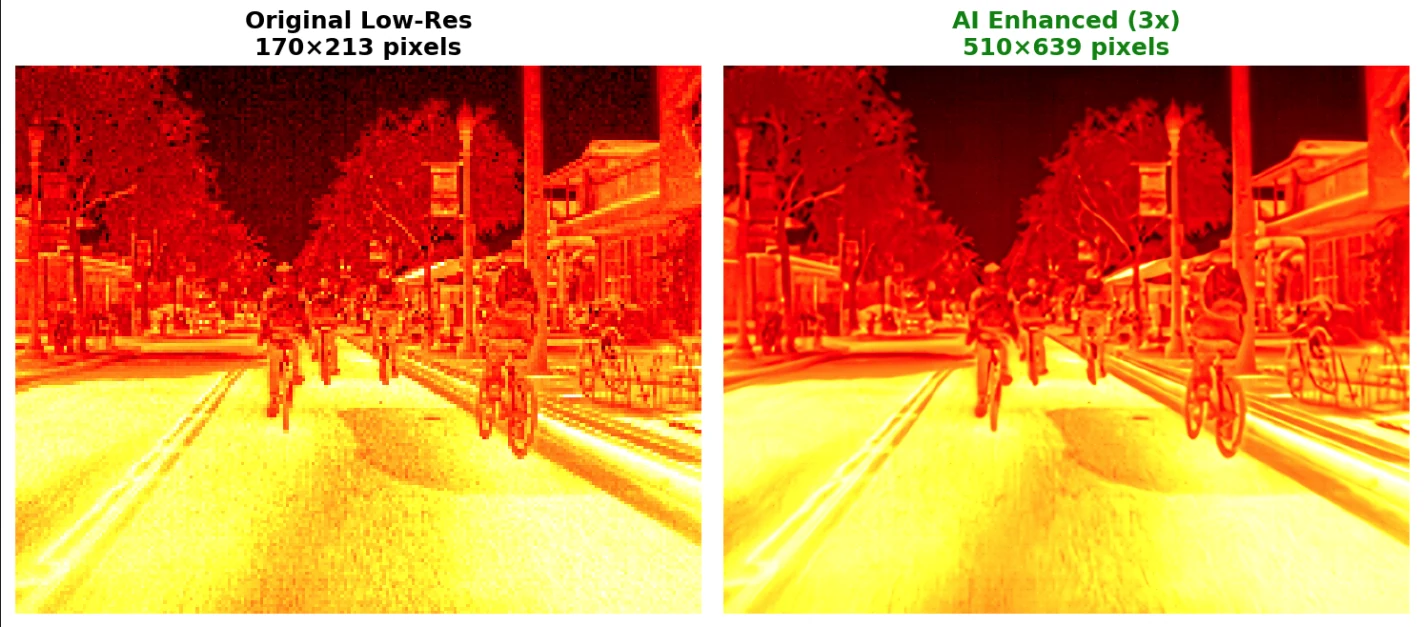
- 31.0 dB / 0.757
- ×3 quality
- PSNR / SSIM
- 29.6 dB / 0.713
- ×4 quality
- PSNR / SSIM
- ~45 FPS
- Edge inference
- NVIDIA Jetson Orin, after quantization
From the project
For engineersHow it is built, its limits, and its keywords.
How it works
The IMDN architecture is adapted to a single channel, pretraining is transferred from RGB data, a thermal-specific training objective shifts attention toward heat-relevant gradients and contrast, and the model is optimized toward FP16 and INT8 execution on NVIDIA Jetson hardware.
Limits
- Reported quality numbers are dataset-specific and become less constrained at larger enlargement factors.
- “Real time” is a property of a full pipeline on named hardware at a named input size, not of a model file. The ~45 FPS figure is on NVIDIA Jetson Orin after quantization; that Jetson benchmark is not in the public repository yet.
- Speed figures measured elsewhere, such as the desktop-GPU run in the repository’s evaluation report, used different hardware and protocols, so I keep them apart from the Jetson figure.
- The next real test is task-based: does downstream detection actually improve?
Keywords
- thermal super-resolution
- IMDN
- Jetson Orin
- edge inference
- single-channel super-resolution